
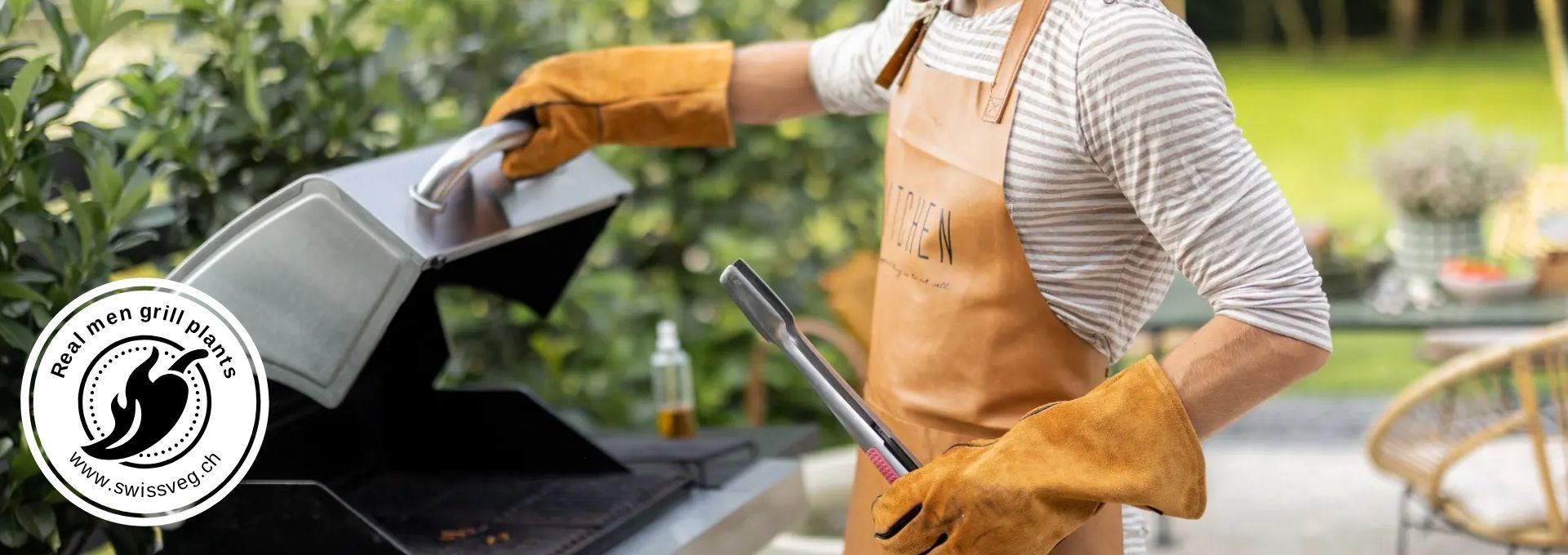
Men at the grill, women taking care of the side dishes: it is a scene that plays out thousands of times every summer in Switzerland. Although gender equality is well established in many areas of life, the division of roles at the grill remains remarkably traditional. The man is in charge of the meat, the woman looks after the sides. Is the grill the last bastion of traditional masculinity?
Men do in fact eat more meat than women. But why is that the case? Researchers have examined how gender equality affects meat consumption.1 The results are remarkable: in countries with a high degree of gender equality, men ate significantly more meat than women. The researchers explained this by suggesting that women in such countries are more able to consciously choose meat-free options. But this explanation does not go far enough. Men in more equal societies would also have the option of choosing plant-based alternatives. So why do they still do this far too rarely? Several studies indicate that being male and being more affluent are the factors most strongly correlated with high meat consumption. Interestingly, there are three large countries (China, India, and Indonesia) where there are no gender-specific differences in meat consumption.
So why do men eat more meat than women in the first place?
One possible explanation lies less in biological differences and more in social and cultural influences. Meat consumption has long been linked to ideas of strength, performance, and status, traits that are traditionally associated more with masculinity. Several studies show that men are more likely to align their eating habits with these kinds of social expectations. Meat is not just perceived as food but also as a symbol. Plant-based eating, on the other hand, is often associated with concepts such as health, lightness, or sustainability. These are all qualities that are culturally less strongly connected with classic images of masculinity.
However, these attributions are not given by nature but shaped by society. Nevertheless, they often influence our everyday decisions unconsciously, including when we are grilling. This is precisely why it is worthwhile to rethink the image of “manly grilling.” What is considered self-evident today is often the result of habit and cultural conditioning and cannot be explained by “male biology.”
Rethink traditions
Anyone who ventures into plant-based grilling quickly notices that completely new possibilities open up. Using a wide variety of plant-based ingredients such as celeriac, beetroot, or mushrooms, it is possible to prepare hearty dishes with bold flavors that are just as filling and enjoyable as classic meat dishes. And the best part is that much-loved traditions do not have to be abolished, only reimagined. Instead of a rump steak, a juicy vegan burger can go on the grill, or, for vegetable lovers, a beet steak. It is a small swap with a big impact for animals, people, and the environment, which at the same time opens up new worlds of flavor.
- Hopwood, C. J., Zizer, J. N., Nissen, A. T., Dillard, C., Thompkins, A. M., Graça, J., Waldhorn, D. R. & Bleidorn, W. (2024). Paradoxical gender effects in meat consumption across cultures. Scientific Reports, 14(1), 13033. https://doi.org/10.1038/s41598-024-62511-3